
What can you do when your dog gets anxious and frantic when you leave them alone at home?
This is not an easy thing to deal with, trust me, we are going through it right now at home with Leo! Well, for a start, dogs are a highly social species and they love company. But like human individuals they vary enormously in their personalities and in their capacity to be self confident and self contained when they are left alone.
Dogs can be destructive when left alone in the house, but there can be many different reasons for it, perhaps not separation anxiety but perhaps boredom or sometimes even separation elation! so it is wrong to make a diagnosis without further investigation. A good place to start is to set up a video camera on a tripod when you go out and see how your dog reacts. Just general chewing and destructiveness is probably boredom. When the destructiveness is aimed at the doors and windows in an attempt to escape, then this is a more serious problem, and you should seek professional help.
The indications of anxiety start way before you leave the house, your dog is watching you for clues that something bad is going to happen. Picking up keys, putting on shoes, or even looking at the clock at a certain time of the day can start to get the dog anxious. They are expert at back-calculating your actions to predict your future movements!
Sometimes dogs that are over-bonded with their owners can get especially anxious when separated, this can be a common problem with rescue dogs that bond with new owners! These type of dogs follow you around the house, up the stairs, down the stairs, into the kitchen, into the toilet.. you get the idea? Known in the trade as 'velcro dogs' because they stick to you like velcro!
These problems can take a long time to get better, your dog must get used to short absences, even not being in the same room can make them anxious, so a start might be a baby-gate in the house where they cannot be with you but they start to get used to being further distances from you. Just shutting back doors and front doors as you go out into the front or back garden without them for a minute or so might get them used to short periods of absence. Little and often, and don't go too far too soon or you will spoil all your hard work!
Give your dog a comfy, safe den for a bed, hidden in a corner. They will like to go there when they want to feel safe. Give your dog a chew toy or puzzle to solve while you leave for a minute - they might not even notice you are gone!
There is no quick fix!! I know! 4 months and counting - but we are getting there!
Friday, 1 July 2011

Thursday, 2 June 2011
Kong - How do You Eat Yours?
Kongs are wonderful! Don't just take my word for it, try it for yourself! For the unenlightened a Kong is a hollow rubber dog toy that you can stuff with food. Dogs can take ages and ages just licking the food out from inside. Just about a tablespoon of food can last 40 or 50 minutes if you do it right!
 Anything you can think of really, a few dog biscuits, left over pate, cheese, pilchards, sardines, ham, chicken, vegetables, held together with a small spoon of peanut butter and a hint of marmite!
 Or if you like it fiendishly difficult, block up the small end with a piece of bread, break in a couple of eggs and a few biscuits and cook in the microwave till the eggs are hard! How long do you think it could take to lick an egg out of the middle? Or how about a few dog biscuits layered with some grated cheese - melted in the microwave then chilled in the fridge till it is hard! Or better still serve it frozen straight from the freezer! That takes ages to eat and dogs really enjoy the experience.
 Dogs experience real enjoyment at taking time over their food, isn't it a shame that most people feed their dogs from a bowl and it is all over in 20 seconds! As long as the food is part of their recommended daily amount, then why not spread their food throughout the day with a Kong. A very common reason for aggression or strange behaviour is due to low blood sugar or hypoglycaemia. It is a bad mistake just to feed your dog just once in the day - they should have several smaller meals throughout the day, levelling out blood sugar. Kongs are brilliant! How do you eat yours?
 Don't just take my word for it, try it for yourself! For the unenlightened a Kong is a hollow rubber dog toy that you can stuff with food. Dogs can take ages and ages just licking the food out from inside. Just about a tablespoon of food can last 40 or 50 minutes if you do it right!
 Anything you can think of really, a few dog biscuits, left over pate, cheese, pilchards, sardines, ham, chicken, vegetables, held together with a small spoon of peanut butter and a hint of marmite!
 Or if you like it fiendishly difficult, block up the small end with a piece of bread, break in a couple of eggs and a few biscuits and cook in the microwave till the eggs are hard! How long do you think it could take to lick an egg out of the middle? Or how about a few dog biscuits layered with some grated cheese - melted in the microwave then chilled in the fridge till it is hard! Or better still serve it frozen straight from the freezer! That takes ages to eat and dogs really enjoy the experience.
 Dogs experience real enjoyment at taking time over their food, isn't it a shame that most people feed their dogs from a bowl and it is all over in 20 seconds! As long as the food is part of their recommended daily amount, then why not spread their food throughout the day with a Kong. A very common reason for aggression or strange behaviour is due to low blood sugar or hypoglycaemia. It is a bad mistake just to feed your dog just once in the day - they should have several smaller meals throughout the day, levelling out blood sugar. Kongs are brilliant! How do you eat yours?
Saturday, 14 May 2011
Hydrotherapy for Dogs
Leo went swimming yesterday! Many dogs nowadays suffer from hip and elbow dysplasia as a direct result of poor breeding. Breeding from dogs who have badly formed hip joints passes down this fault to its offspring. Many reputable breeders have their breeding dogs x-rayed and their hips are examined for health and given a 'hip-score'. Good healthy hip and elbow joints are well formed and have little excess movement beyond normal motion. Over the years of a dog's life, arthritis can cause stiffness and pain in older age.
Leo is 11 years old and has hip and elbow dysplasia and arthritis. Exercise in water can strengthen and build muscle around the joints which can help support and protect them.
 After a quick Google search for canine hydrotherapy in my area I found a wonderful centre just a couple of miles away. Qualified canine physiotherapist shown here, helped him around the pool for the first couple of minutes, then when he had got used to the idea she threw a tennis ball over the other side of the pool and he was off on his own like a torpedo!!
 Walking on dry land can be quite painful with arthritis and he can only manage a 10 minute walk before pain slows him down. Swimming is brilliant for this type of health problem in older dogs, he can maintain good mobility and stamina. We look forward to many more sessions.
 Many dogs nowadays suffer from hip and elbow dysplasia as a direct result of poor breeding. Breeding from dogs who have badly formed hip joints passes down this fault to its offspring. Many reputable breeders have their breeding dogs x-rayed and their hips are examined for health and given a 'hip-score'. Good healthy hip and elbow joints are well formed and have little excess movement beyond normal motion. Over the years of a dog's life, arthritis can cause stiffness and pain in older age.
Leo is 11 years old and has hip and elbow dysplasia and arthritis. Exercise in water can strengthen and build muscle around the joints which can help support and protect them.
 After a quick Google search for canine hydrotherapy in my area I found a wonderful centre just a couple of miles away. Qualified canine physiotherapist shown here, helped him around the pool for the first couple of minutes, then when he had got used to the idea she threw a tennis ball over the other side of the pool and he was off on his own like a torpedo!!
 Walking on dry land can be quite painful with arthritis and he can only manage a 10 minute walk before pain slows him down. Swimming is brilliant for this type of health problem in older dogs, he can maintain good mobility and stamina. We look forward to many more sessions.
Saturday, 26 March 2011
Getting Older
I have been thinking about the subject of ageing dogs recently. There are so many similarities in the physical and psychological lives of dogs and humans and ageing is no exception. So in the following sentences, when I refer to dogs then you could replace it with the word 'human' and I think it would still apply!
Older dogs really appreciate routine and predictability. Older dogs find change in lifestyle and habits quite difficult to cope with. Older dogs can suffer a gradual hearing loss and poor eyesight, and they really appreciate a comfy bed or chair that is easy to get on and off.
What I have been thinking about recently is that because you see your dog every single day, then perhaps you don't notice the subtle changes which happen very, very slowly. I remember listening to an excellent piece of wisdom from a Vet who said that slowing down and having stiff joints is not necessarily a normal and predictable part of growing old for dogs. Dogs, by their nature as predators put on an act so as not to be seen as vulnerable to other dogs and people. If they are in pain, they hide it for as long as possible. If they have painful joints they don't want other dogs or people to know about it and they really don't moan about their aches and pains. If you have an older dog and you think it is just slowing down and getting less active, then the chances are that they are in pain and they don't want anyone to know.
I have just started Leo the Lab on a course of dietary supplements (mainly glucosamine/chondroitin) to assist with osteo arthritis. There has been a massive leap forward in the scientific understanding of these type of supplements. Please go and ask the advice of your vet. Don't just slip a few extra shop bought supplements into his food and hope for the best, dogs have a very different digestive system from humans and they require very specific doses.
Getting slower is not just a normal part of ageing for a dog, he might be in pain and you don't know it. Go see your vet and get it checked out. You might be amazed at the difference these supplements can make, and your dog will thank you for it.
Older dogs really appreciate routine and predictability. Older dogs find change in lifestyle and habits quite difficult to cope with. Older dogs can suffer a gradual hearing loss and poor eyesight, and they really appreciate a comfy bed or chair that is easy to get on and off.
What I have been thinking about recently is that because you see your dog every single day, then perhaps you don't notice the subtle changes which happen very, very slowly. I remember listening to an excellent piece of wisdom from a Vet who said that slowing down and having stiff joints is not necessarily a normal and predictable part of growing old for dogs. Dogs, by their nature as predators put on an act so as not to be seen as vulnerable to other dogs and people. If they are in pain, they hide it for as long as possible. If they have painful joints they don't want other dogs or people to know about it and they really don't moan about their aches and pains. If you have an older dog and you think it is just slowing down and getting less active, then the chances are that they are in pain and they don't want anyone to know.
I have just started Leo the Lab on a course of dietary supplements (mainly glucosamine/chondroitin) to assist with osteo arthritis. There has been a massive leap forward in the scientific understanding of these type of supplements. Please go and ask the advice of your vet. Don't just slip a few extra shop bought supplements into his food and hope for the best, dogs have a very different digestive system from humans and they require very specific doses.
Getting slower is not just a normal part of ageing for a dog, he might be in pain and you don't know it. Go see your vet and get it checked out. You might be amazed at the difference these supplements can make, and your dog will thank you for it.
Monday, 14 March 2011
Bonding!
We've bonded! It takes quite a while longer for a rescue dog to settle into a new home than you might think. Routine is important, what he is allowed to do and what he isn't. What time is dinner time and what time is walkies. A new dog must also 'bond' with a new owner. Scientific studies have proved that the hormone 'oxytocin' is produced when owners stroke and cuddle their dogs. This is the same hormone that a mother produces when she is feeding her baby. This is a bonding hormone and it really does work between humans and dogs.
This week we have been bonding. Lots of eye contact, lots of physical contact, lots of play, lots of gentle grooming. All these activities are bonding. So now, just after 7 days in a new home it really does feel like I am 'in love' again. We have bonded!
 It takes quite a while longer for a rescue dog to settle into a new home than you might think. Routine is important, what he is allowed to do and what he isn't. What time is dinner time and what time is walkies. A new dog must also 'bond' with a new owner. Scientific studies have proved that the hormone 'oxytocin' is produced when owners stroke and cuddle their dogs. This is the same hormone that a mother produces when she is feeding her baby. This is a bonding hormone and it really does work between humans and dogs.
This week we have been bonding. Lots of eye contact, lots of physical contact, lots of play, lots of gentle grooming. All these activities are bonding. So now, just after 7 days in a new home it really does feel like I am 'in love' again. We have bonded!
Sunday, 6 March 2011
The Amazing Thing About Dogs

It's Iditarod time again! Every Winter the Iditarod sled dog race takes place in Alaska. For more than 1100miles teams of sled dogs race through unbelievable conditions from Anchorage to Nome. The best racers can do it in about 8 or 9 days. That's more than 100miles of running per day! 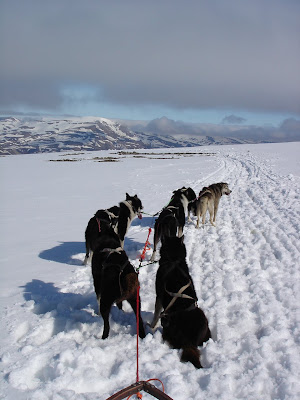 I just adore the sport of dog sledding! This is a fantastic example of dogs doing what they were bred to do. They love it! Can you imagine running 100miles a day and still wanting more? These dog athletes are amazing! They are the equivalent of a world class athlete! There is a very special bond between a musher and his dogs. Science is still learning incredible things about how a dog metabolises so much energy from its food! The amazing thing about these dogs is that they love to work! They love life! Can you imagine how much fun it would be going to work every day when you had colleagues like this?
 I just adore the sport of dog sledding! This is a fantastic example of dogs doing what they were bred to do. They love it! Can you imagine running 100miles a day and still wanting more? These dog athletes are amazing! They are the equivalent of a world class athlete! There is a very special bond between a musher and his dogs. Science is still learning incredible things about how a dog metabolises so much energy from its food! The amazing thing about these dogs is that they love to work! They love life! Can you imagine how much fun it would be going to work every day when you had colleagues like this?
Thursday, 17 February 2011
Letting Go
Readers of my other blog will know that last week I had to say goodbye to my Buddy. He was 15 years old and had a stroke. Unable to stand up and showing no signs of recovery we called the vet and he went to sleep peacefully at home. It is a responsibility that we have when we own dogs. When to think of their welfare before our own. We want them to stay with us just a few days more, we want them to get better, we want them to keep us company for just a bit longer...we want..we want..we want.
In fact, the whole act of having a dog live with us in our houses, to keep us company is selfish. A wonderful book I read on the subject is 'The Culture Clash' by Jean Donaldson. We expect dogs to come into our houses and live with us as humans live. We give them human names, even sometimes dress them up in clothing (oh how I hate that!).
So, letting go of a beloved pet is a real bereavement. A big hole in our lives, an empty space, no one to lick the plates clean! So in their best interest, when the time comes, we must let go. With dignity, at peace and just one day too soon, and never, ever... one day too late.
 He was 15 years old and had a stroke. Unable to stand up and showing no signs of recovery we called the vet and he went to sleep peacefully at home. It is a responsibility that we have when we own dogs. When to think of their welfare before our own. We want them to stay with us just a few days more, we want them to get better, we want them to keep us company for just a bit longer...we want..we want..we want.
In fact, the whole act of having a dog live with us in our houses, to keep us company is selfish. A wonderful book I read on the subject is 'The Culture Clash' by Jean Donaldson. We expect dogs to come into our houses and live with us as humans live. We give them human names, even sometimes dress them up in clothing (oh how I hate that!).
So, letting go of a beloved pet is a real bereavement. A big hole in our lives, an empty space, no one to lick the plates clean! So in their best interest, when the time comes, we must let go. With dignity, at peace and just one day too soon, and never, ever... one day too late.
Subscribe to:
Posts (Atom)


